How UCR’s CAV Team is Enhancing Lane Centering and Localization
Driving Precision and Advancing Lane Centering with Gage Shaddock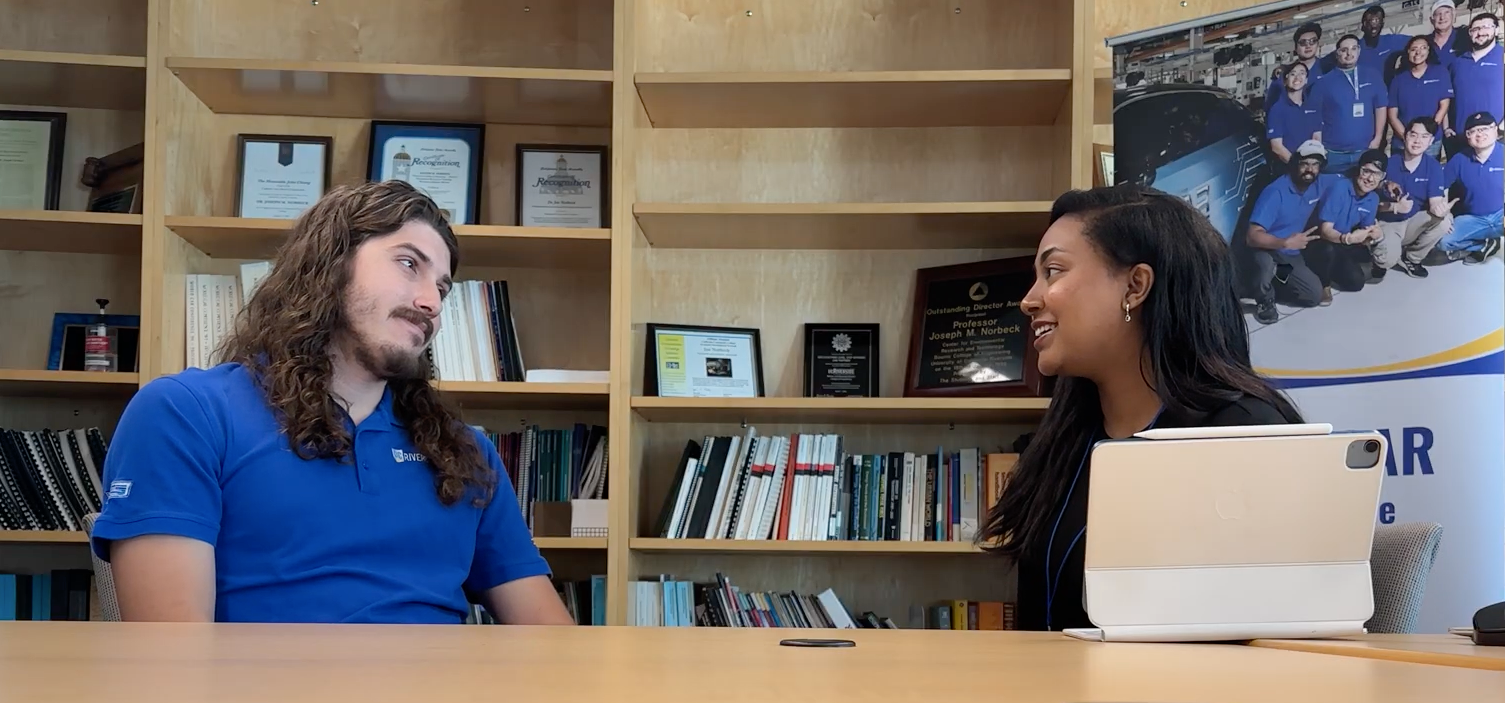
At the University of California, Riverside, the EcoCAR EV Challenge is driven by teams working at the forefront of vehicle automation. Among them is the Connected and Automated Vehicles (CAV) subteam, where students are developing advanced systems that bring autonomous driving closer to reality.
One of the key contributors to this effort is Gage Shaddock, a member of the CAV subteam, who has been actively working on improving how vehicles understand their position and navigate safely.
Building Smarter Vehicle Control Systems
Gage joined EcoCAR in Spring 2025 and quickly became involved in developing lane centering systems, technology that helps a vehicle stay accurately within its lane while driving.
The CAV subteam focuses on high-level autonomous features, including:
- Lane centering
- Adaptive cruise control
- Intersection navigation
These systems work together to create a smoother, safer driving experience. As part of this effort, Gage’s team is also integrating new in-vehicle displays and improving how the vehicle responds to real-time environmental inputs.
The Role of Localization in Autonomous Driving
A major focus for Gage’s team this year has been the localization subsystem, a critical component that determines the vehicle’s exact position.
Using advanced GPS technology supported by a sponsor-provided system, the team is able to:
- Improve positional accuracy (latitude and longitude)
- Reduce latency in data processing
- Share precise location data with nearby vehicles
As Gage explains:
“The goal is to be as accurate as possible and reduce latency so we can quickly determine our position and broadcast it to other vehicles.”
This system works by combining data from multiple sources, including GPS signals, LiDAR sensors, and wheel-based measurements. Together, these inputs allow the vehicle to calculate its exact position in real time and communicate that information externally.
To ensure reliability, the team follows a structured testing process:
- Simulation testing
- Hardware integration
- Real-world vehicle testing
This step-by-step approach allows the team to validate system performance before deploying it on the vehicle. As described in the interview, testing focuses not only on technical accuracy, but also on how the system performs in real driving conditions—how it feels, responds, and adapts.
Collaboration Across Teams
Developing these systems requires close collaboration across multiple subteams, particularly between CAV and Propulsion, Controls, and Modeling (PCM).
Gage emphasized the importance of teamwork, especially when overcoming challenges such as cybersecurity integration and system compatibility. Through tools like Discord, ClickUp, and regular team meetings, the team ensures alignment and progress across all areas.
As the team approaches competition, the focus has shifted toward final testing and refinement. While some development work remains, the priority is ensuring that all systems, lane centering, localization, and adaptive cruise control, perform reliably in real-world conditions.
Beyond technical development, Gage highlighted the personal growth that comes from the experience:
Through his work on the team, he has strengthened not only his technical expertise, but also his leadership, communication, and collaboration skills.
Gage’s work reflects a broader mission within EcoCAR: to develop intelligent vehicle systems that improve both safety and efficiency.
By combining precise localization, real-time data processing, and advanced control systems, the CAV team is contributing to the future of connected and automated mobility—one where vehicles are not only smarter, but also safer and more responsive.
Want to learn more or get involved with EcoCAR UCR? Follow EcoCAR UCR on Instagram , LinkedIn, and visit our Linktree to explore opportunities, open roles, and behind-the-scenes updates from Year 4.
Let us help you with your search