Driving Innovation with Speedgoat
Powering Real-Time Vehicle Development at UCR EcoCARAt the University of California, Riverside, the EcoCAR EV Challenge brings together students, industry, and advanced technology to push the boundaries of electric vehicle innovation. Behind the scenes, critical sponsor partnerships make this level of development possible, one of which is Speedgoat, a key contributor to the team’s vehicle performance and testing capabilities.
Through its advanced hardware systems, Speedgoat enables students to move beyond theory and into real-time vehicle development, bridging the gap between classroom learning and industry application.
Building the Backbone of Vehicle Control
Communications Manager Semaria Kebde and Will Snyder, Year 4 Systems, Design, and Integration (SDI) Graduate Lead, sat together to discuss how Speedgoat plays a foundational role in the vehicle’s operation.
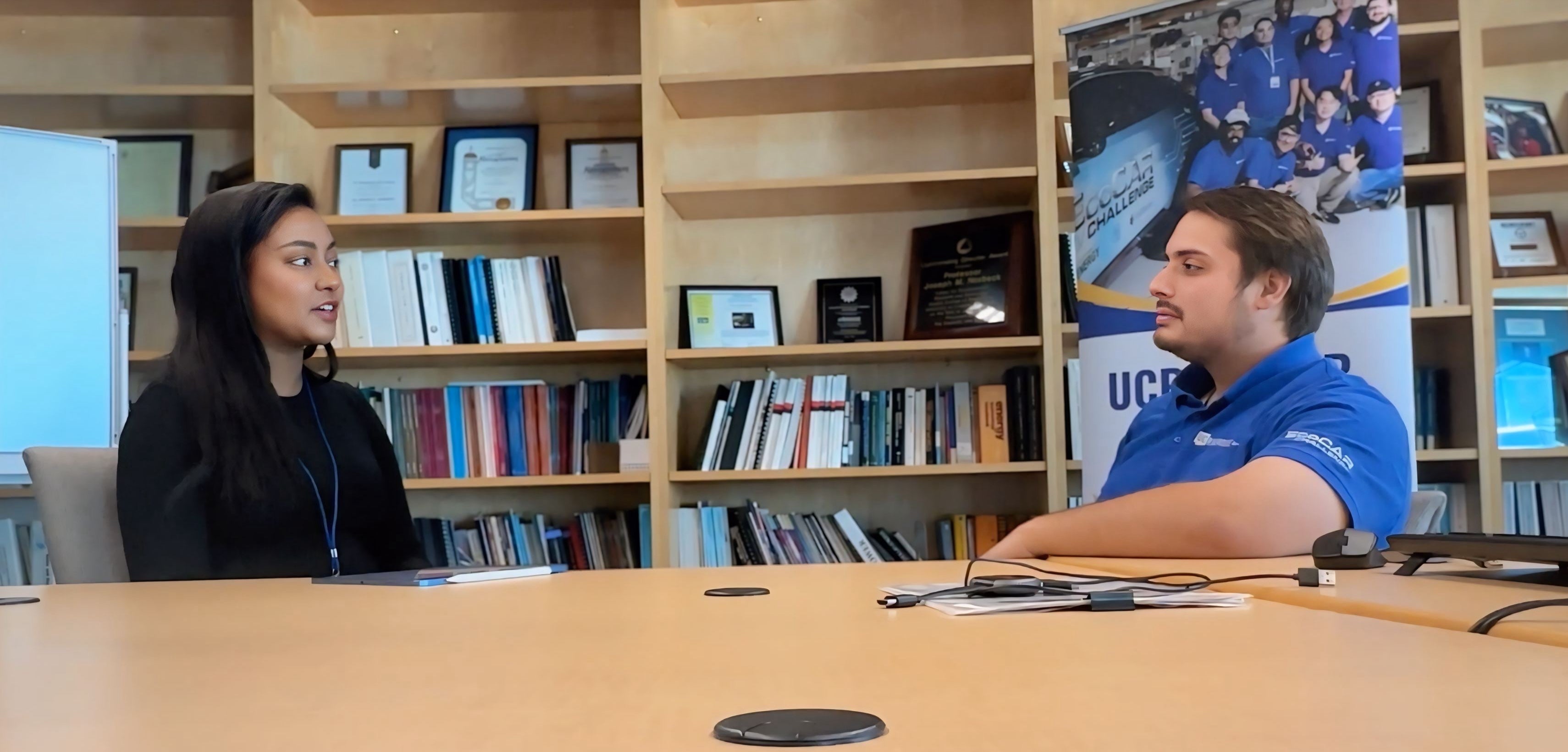
According to Will,
“Without the Speedgoat, the motor is just going to sit there… It’s not actually going to spin.”
Acting as the intermediary between the vehicle and the electric motor, the Speedgoat system ensures that the car can interpret driver inputs, communicate across subsystems, and safely deliver power from the battery.
Beyond simply enabling motion, it supports critical functions such as:
- Communicating with vehicle subsystems through CAN networks
- Managing high-voltage safety systems
- Translating driver inputs into real-time motor commands
This level of integration allows the vehicle to behave more like a production-ready electric vehicle rather than a student prototype.
Rapid Prototyping in Action
One of Speedgoat’s most valuable contributions is its ability to support rapid prototyping.
Unlike traditional vehicle controllers, which are fixed once programmed, Speedgoat allows students to continuously update and test control algorithms in real time.
“It’s meant to constantly receive new code… so teams can make quick changes and test them on the vehicle.”
This flexibility gives students the ability to iterate quickly, refine performance, and identify issues early—mirroring the development cycles used in the automotive industry.
From Simulation to the Real World
Before any code is deployed on the vehicle, it is rigorously tested using Hardware-in-the-Loop (HIL) systems, also powered by Speedgoat.
These systems simulate real-world driving conditions, allowing students to validate their algorithms in a safe, controlled environment.
“If it passes HIL, then we can push it onto the car… it prevents major problems before real-world testing.”
By combining simulation with real hardware, students gain hands-on experience with one of the most sought-after skills in the automotive industry.
Preparing Students for Industry
For many students, working with Speedgoat represents a turning point in their education.
EcoCAR provides an environment where theoretical concepts from coursework, such as control systems and system modeling, are applied directly to real vehicle systems.
“There’s a massive divide between learning the theory and applying it in reality. EcoCAR bridges that gap.”
This hands-on experience gives students a significant advantage when entering the workforce, equipping them with practical skills and familiarity with industry-standard tools.
A Direct Connection to Industry Practices
Speedgoat is widely used across the automotive industry for simulation and control system development, making it a powerful tool for preparing students for future careers.
“If it’s running on a car, it was probably running on a Speedgoat unit at some point.”
By working with the same tools used by industry professionals, students are able to transition more seamlessly into engineering roles after graduation.
Beyond its technical impact, Speedgoat also plays a role in shaping how students think and learn as engineers.
Through iterative testing, debugging, and real-world deployment, students experience the full engineering lifecycle—from concept to implementation.
Will emphasizes that this process is where real learning happens:
“They go from not knowing what they’re doing to building something that works… and that’s when it really clicks.”
As the EcoCAR team moves closer to competition, tools like Speedgoat will continue to play a critical role in refining vehicle performance and enhancing the driving experience.
From enabling real-time control systems to supporting advanced testing environments, Speedgoat is more than just a sponsor; it is a key driver of innovation, learning, and success at UCR.
Want to learn more or get involved with EcoCAR UCR? Follow EcoCAR UCR on Instagram, LinkedIn, and visit our Linktree to explore opportunities, open roles, and behind-the-scenes updates from Year 4.
Let us help you with your search